You never quite know what to expect bird wise when you’re at Whitefish Point. I am always interested in what raptors appear, when they appear and in what numbers.

Rough-legged Hawks seem to fly in any weather, regardless of the temperature or wind direction. The same applies to Sharp-shinned Hawks and Turkey Vultures. Red-tailed Hawks and a bit more sensitive to wind direction. I’ve had days this April with large numbers of Red-tails, Rough-legs and Turkey Vultures and days with few or none. But it’s when the unexpected shows up that everybody gets excited. Recently, there have been many days with American Goshawks (formerly Northern Goshawk). The first Broad-winged Hawk showed up yesterday. And – for the past three days Short-eared Owls have been around. But yesterday late in the morning an unexpected migrant appeared.
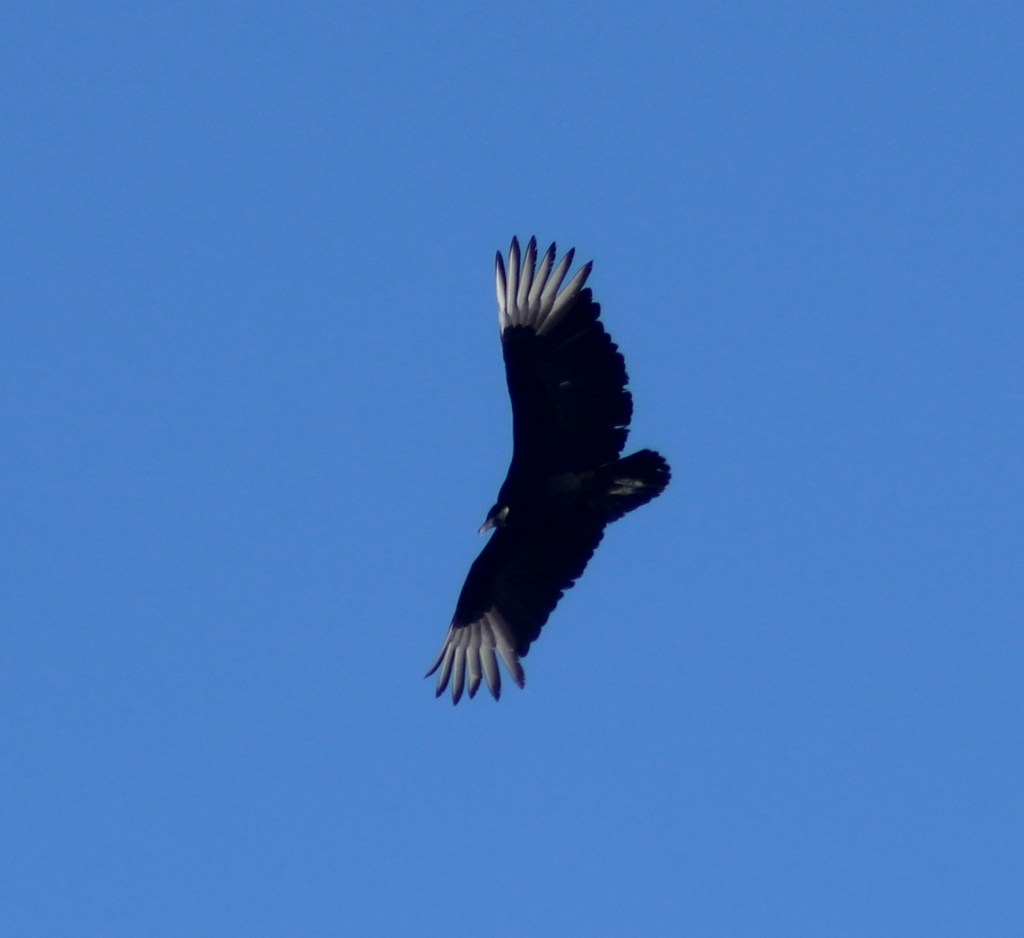
This Black Vulture is perhaps the third record of one at Whitefish Point. I was fortunate to seen the one that was here two years ago. But having one over our property was exciting.
Black Vultures are expanding their breeding range northwards. Similarly, Blue Grosbeaks are doing the same. The difference is that the grosbeaks are already nesting in southern Michigan. This is echoing the northern movement of Turkey Vultures and Northern Cardinals over 150 years ago. Those are now common in Michigan and expanded into Ontario in the early 1900s.
So the question is when will Black Vultures become a regular nesting species in the state?
Another question is why have all of these bird expanded their ranges north? Climate change is the driving factor. As the planet has warmed species of all sorts have expanded their ranges northerly. Birds, plants, mammals, even insects are moving north. This will continue until something is done about the human impact on global warming and overall climate change.
More later…
 Michael's Place